Noodle Architecture: The Pasta Plating Movement That Forgot You Have to Actually Eat It
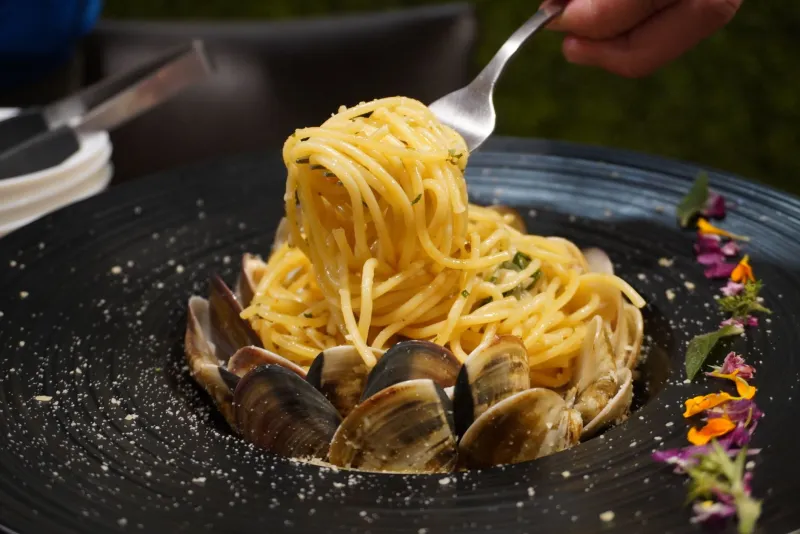
There is a moment — and if you've eaten at a certain tier of American restaurant in the last fifteen years, you know exactly the moment I mean — when a plate arrives at your table and you genuinely cannot tell if it's food or a science fair project. The pasta is not sitting on the plate. It is standing. Coiled into a tight helix, balanced on a smear of sauce, reaching upward with the confidence of a man who has never once eaten spaghetti without destroying his shirt.
You look at it. It looks back at you. Nobody moves.
This is the pasta tower. And we need to talk about it.
How Did We Get Here
Italian grandmothers did not do this. Let's just establish that upfront. Nonna was not using tongs and a ladle to construct a spiraling column of bucatini at the center of a wide, white bowl. Nonna put the pasta in the bowl, put the sauce on the pasta, and handed it to you with a look that suggested you should eat it before it got cold, which was approximately eleven seconds from now.
The vertical pasta trend traces its roots to the 1990s and early 2000s, when American fine dining entered what food historians might charitably call its "architecture phase." Chefs, newly emboldened by the rise of culinary celebrity and the discovery that people would pay extra for things that looked hard to make, began treating the plate as a canvas and the food as a medium. Height became a signal of effort. Drama became a substitute for simplicity. And somewhere in that cultural shift, someone twirled a nest of angel hair onto a carving fork, slid it onto a plate, and called it a tasting course.
The Michelin crowd lost its collective mind.
The Physics Problem Nobody Wanted to Acknowledge
Here is the fundamental issue with vertical pasta that no amount of culinary school training can solve: pasta is heavy, wet, and structurally indifferent to your ambitions for it.
A tower of tagliatelle is not load-bearing. It is not engineered. It is a temporary arrangement of cooked flour and egg that will, with absolute certainty, begin its collapse the moment it leaves the kitchen pass. By the time the server has walked from the expo window to your table — a journey that takes, generously, forty-five seconds — the tower has already begun its structural negotiation with gravity.
What arrives at your table is not the tower. It is the memory of a tower. A monument to a brief moment of hope that has since softened, shifted, and begun a slow migration toward the rim of the plate.
And then the server sets it down, and you're supposed to just... eat it? How? Do you stab it from the top like you're planting a flag? Do you dismantle it from the base? Do you eat around the outside like you're excavating something? Nobody tells you. There is no instruction card. You are on your own with a pile of expensive noodles and the growing suspicion that the chef has never actually consumed food.
A Completely Honest Structural Integrity Report by Pasta Shape
Not all pastas are equally victimized by the tower treatment. In the interest of public service, here is an assessment of which shapes can survive the ordeal and which ones should be protected by law from ever being plated vertically.
Spaghetti and Linguine: Theoretically twirl-able, but the resulting structure has the tensile strength of wet newspaper. Will collapse mid-presentation. The server will pretend not to notice.
Tagliatelle and Pappardelle: Wide, flat, and absolutely not interested in being coiled. What looks like a confident tower in the kitchen is a warm tangle by the time it reaches you. Points for effort; zero points for execution.
Rigatoni and Penne: Cannot be stacked vertically without some kind of culinary cement, which is a real technique some restaurants actually use and which should be investigated by someone with authority.
Gnocchi: Not pasta, but gets subjected to this treatment anyway. Gnocchi stacked in a tower is just a pile of gnocchi with delusions of grandeur. The bottom ones are always cold.
Orzo: If a restaurant tries to plate orzo vertically, leave. Just leave.
The Waiter's Impossible Job
Spare a thought, briefly, for the server tasked with delivering a pasta tower to your table. They have been handed a plate in the kitchen, told not to tilt it, and sent on a journey across a dining room full of chairs, other servers, and at least one toddler. They know the tower is already compromised. They can feel it shifting. But their job is to present it to you with the same confidence they'd use to describe a wine pairing, set it down gently, and say "the chef has done a wonderful tagliatelle this evening" without a single muscle in their face acknowledging that what they've just placed in front of you looks like it was in an accident.
This is a performance. Respect it, even as you watch the whole thing slowly slide.
In Defense of the Flat Plate
There is a quiet revolution happening in American dining, and it is the return of pasta that simply lies down. Flat. Horizontal. At peace with itself and with the laws of thermodynamics. Restaurants that plate a wide bowl of cacio e pepe as nature intended — loose, glossy, pooled slightly at the center, ready to be eaten immediately — are making a statement. The statement is: we trust the food.
You don't need a tower to signal that something took effort. A perfectly emulsified sauce coating every strand of spaghetti is harder to achieve than a spiral on a fork. A pasta that arrives at your table at the correct temperature, in the correct quantity, and in a format that allows you to eat it without a structural engineering consultation is, in fact, the most impressive thing a kitchen can do.
Nonna knew this. She always knew this.
Eat your pasta. Let it be flat. And if someone sends you a tower, quietly dismantle it with your fork and never speak of it again.