Dirty Hands, Clean Conscience: A Completely Unscientific but Deeply Committed Ranking of Foods You Should Eat With Your Fingers

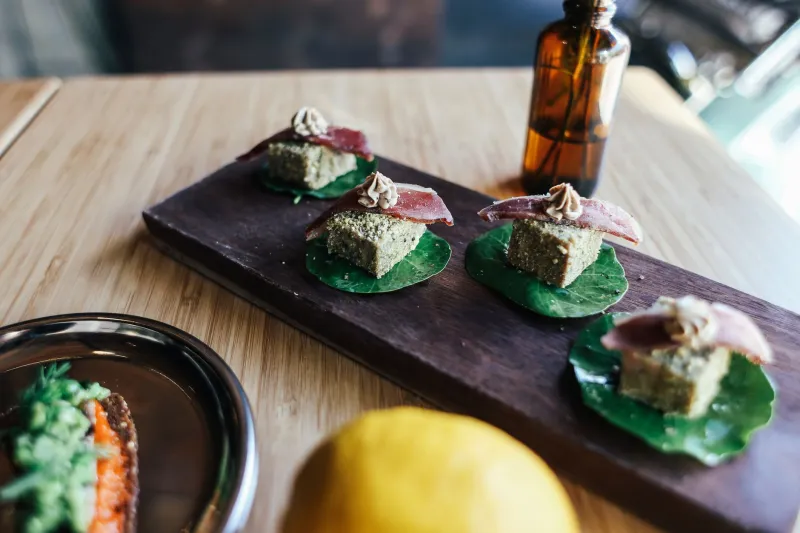
Photo by Photo by Guillermo Nolasco on Unsplash on Unsplash
There is a specific kind of social paralysis that descends when you're sitting in a restaurant that's slightly nicer than you expected, staring at a food that your hands know how to eat but your brain is worried your server will judge. The fork is in your hand. The food is on the plate. And somewhere in the distance, a busser is watching.
This is the finger food dilemma — and it is far more widespread, far more anxiety-inducing, and far more hypocritical than the restaurant industry will publicly admit.
We spent considerable time (and napkins) investigating which foods genuinely call for fingers, why restaurants simultaneously encourage and silently condemn the practice, and exactly how many Michelin-starred establishments have a secret chicken wing policy. The results were illuminating. The napkin situation was significant.
First, A Defense of the Human Hand
Before we get to the rankings, let's acknowledge what the food science community has been quietly saying for years: your hands are actually excellent eating instruments.
Research from institutions including the University of Oxford suggests that touch enhances flavor perception — that physically handling food activates sensory pathways that utensils simply bypass. When you eat a strawberry with your fingers, you feel its give, register its temperature, and engage with it in a way that a fork-spear simply doesn't replicate. This is not an excuse. This is neuroscience. We are choosing to use it as an excuse.
Beyond the sensory argument, there's the structural one. Certain foods are architecturally incompatible with cutlery. A taco does not submit to a fork. A chicken wing disassembles under the pressure of a knife in ways that are both messy and spiritually defeating. A lobster claw requires a cracker, a pick, and at minimum one hand, and anyone who tells you otherwise is lying or dining at a level of formality that has left the rest of us behind.
The Rankings (Eyebrow-Twitch Scale: 1–5)
Chicken Wings — Twitch Level: 1 (At Sports Bars) to 4 (Everywhere Else)
Chicken wings are the great American finger food contradiction. At a sports bar, eating wings with your hands is not only accepted but expected — the napkin dispenser is right there, the wet wipes arrive automatically, and nobody has ever in recorded history asked for a fork at Buffalo Wild Wings and been taken seriously.
Move that same wing to a hotel restaurant, a rooftop bar with ambient lighting, or — and this is where things get interesting — a tasting menu that includes a "heritage chicken preparation" in the middle courses, and suddenly the air changes. Servers at two separate upscale establishments in New York and San Francisco confirmed, off the record, that they've watched guests struggle through bone-in chicken courses with silverware out of sheer social terror.
"We always want to tell them it's okay to use their hands," said one server in San Francisco. "But we also don't want to imply they're doing it wrong. So we just... leave extra napkins."
This is the wing paradox. The food demands fingers. The setting withholds permission. The napkins are a diplomatic compromise.
Tacos (Any Variety) — Twitch Level: 2
The taco's structural integrity depends entirely on the hand that holds it. A fork-and-knife taco is a taco that has given up, spilling its contents across the plate in a way that is both messy and philosophically troubling. Street tacos, Tex-Mex tacos, elevated restaurant tacos with micro-cilantro and house-made salsa macha — all of them want your hands. Most restaurant servers understand this. The eyebrow twitch here is mild and usually directed at the person who doesn't use their hands, not the one who does.
Regional note: In Texas, asking for a fork with your taco is considered a conversation-ender.
Ribs — Twitch Level: 3
Here's where the hypocrisy gets rich. A full rack of ribs — whether St. Louis style, baby back, or the beef short rib that's been slow-braised for twelve hours and costs thirty-something dollars — is a food that restaurants will present to you on a beautiful wooden board with a linen napkin roll and a small ceramic dish of sauce, and then watch to see what you do.
The answer is: you use your hands. You always use your hands. The meat releases from the bone in a way that rewards a firm two-handed grip and punishes tentative fork work. And yet, at restaurants that consider themselves a cut above casual, there exists this liminal moment where the server sets down the ribs and neither confirms nor denies that your fingers are the correct tool.
Fine dining establishments that serve bone-in short ribs are essentially daring you to maintain your composure. The finger bowl — that small dish of lemon water that arrives with lobster at nicer spots — should be mandatory rib accompaniment. It is rarely provided. This is an oversight with moral dimensions.
Artichoke Leaves — Twitch Level: 2.5
The steamed artichoke is one of the few foods where finger-eating is not only correct but literally built into the design. You peel a leaf, drag it through aioli or drawn butter, scrape the flesh with your teeth, and discard the leaf. There is no fork version of this process. The artichoke does not have a fork version.
And yet, at restaurants where artichokes appear on the menu as a starter, there is always — always — someone at a nearby table trying to use a knife and fork, generating a small sad pile of uneaten leaves and a look of quiet defeat. Let the artichoke be what it is. Use your hands. This is what the vegetable is for.
Fancy Sliders — Twitch Level: 4
This is the villain of the list. A slider — inherently a hand food, descended from street food, designed to be consumed in two bites — has somehow migrated onto tasting menus and upscale small-plates programs dressed in brioche buns with wagyu beef and truffle aioli. It arrives on a tiny slate board. It costs fourteen dollars. It is the size of a golf ball.
And the restaurant, having elevated it beyond its station, now expects you to treat it with corresponding formality. Do you pick it up? You should pick it up. It's a slider. But the truffle aioli is going to get on your fingers and the wagyu is going to drip and you're going to spend the rest of the meal subtly wiping your hand on the underside of the tablecloth like a person with no remaining options.
Four-twitch situation. Every time.
The Napkin Compact
What all of this ultimately reveals is that American restaurant culture has a deeply ambivalent relationship with tactile eating. We celebrate finger foods at one end of the dining spectrum — the stadium, the cookout, the county fair — and quietly penalize them at the other, even when the food itself demands them.
The napkin, that humble rectangle of paper or linen, is both the solution and the evidence. More napkins mean more finger food. Fine dining's stingy single-linen-per-guest policy is, in its own way, a position statement about how you're expected to eat.
Mr. Napkins' official stance: eat with your hands when the food calls for it. Request extra napkins without embarrassment. And if a server's eyebrow twitches when you pick up that wing — at a restaurant that put a bone-in wing on the menu — that twitch is the restaurant's problem, not yours.
Your hands were here first.