Off the Plate: A Field Guide to Eating Dinner Off Everything Except an Actual Dish
The plate is one of humanity's great inventions. Flat. Curved at the edges. Holds food. Keeps food from touching other food you didn't want it to touch. Dishwasher safe. The Romans had plates. The Ming Dynasty had plates — extraordinary ones, actually, that we now keep behind glass in museums. The plate is, by any reasonable measure, a solved problem.
And yet.
Somewhere around the Obama administration, American fine dining looked at the plate — this millennia-old triumph of form and function — and said: what if we served the duck confit on a piece of wood instead?
We're still living with the consequences.
A Taxonomy of Crimes Against Dinnerware
Before we go further, let's establish the full scope of what we're dealing with. The non-plate serving surface has proliferated in American restaurants to a degree that demands documentation. Consider this your field guide.
The Slate Tile: The OG offender. Ubiquitous at gastropubs and wine bars from 2010 onward, the slate tile arrived with tremendous confidence and absolutely no structural justification. It is cold. It is heavy. It has a lip situation that can only be described as aspirational. Sauces pool in the center. Things roll off the edges. And yet, it photographs beautifully, which is apparently the only metric that matters.
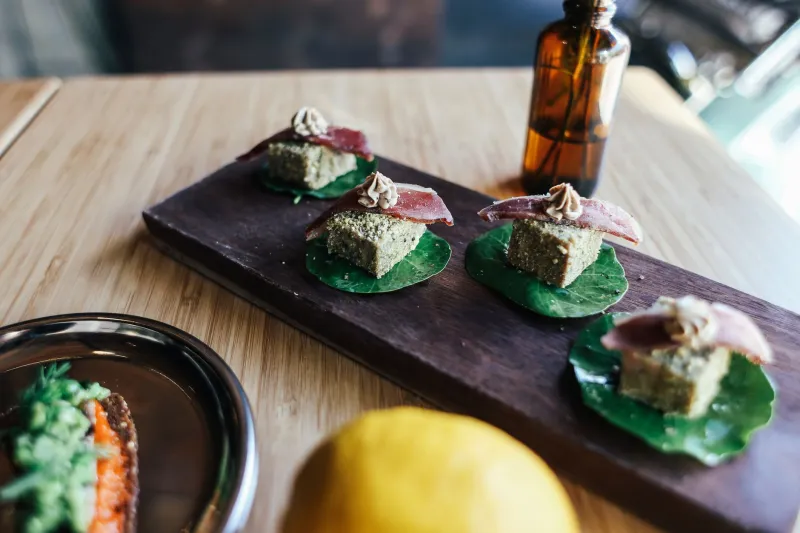
The Wooden Board: Beloved by brunch spots and farm-to-table establishments with exposed brick and a strong opinion about sourdough. The wooden board is at least honest — it knows it's a board. The problem is that boards are porous, which means your servers are either re-seasoning them between services (unlikely) or your appetizer is subtly absorbing the ghost of every charcuterie plate that came before it.
The River Rock / Decorative Stone: We have arrived at the part of the ranking where things get genuinely avant-garde. Somewhere, a chef decided that food should be served on top of rocks, as if we were dining in a primordial riverbed. Usually reserved for amuse-bouches and single bites of something that cost eleven dollars. The rock contributes nothing. The rock is purely vibes.
The Miniature Cast Iron Skillet: Technically a vessel, which gives it more credibility than the slate, but the cast iron skillet is always exactly one thousand degrees when it arrives at your table. The handle is also always exactly one thousand degrees. There are no warnings sufficient to prevent you from touching the handle.
The Literal Log: This is not a hypothetical. Restaurants — real, operating, health-department-approved restaurants — have served food on hollowed-out logs. Usually something smoked, for thematic consistency. Points for commitment. Points deducted for everything else.
The Shovel / Miniature Garden Trowel: Reserved for truffle fries, apparently. Because nothing says elevated casual dining like eating out of a tool designed for moving dirt.
The Instagram Hypothesis
The obvious explanation for all of this is social media, and the obvious explanation is correct, but let's at least be precise about the mechanism.
Instagram didn't just make food more visual — it made food competitive in a very specific way. A plate of pasta on a white ceramic dish is delicious but visually unremarkable. The same pasta served on a reclaimed-wood board with a smear of something on a slate tile beside it and a sprig of something green on a river rock? That's a carousel post. That's three hundred likes. That's a reservation waitlist.
The non-plate surface signals something to the camera: this place is creative, this chef has opinions, this is not your grandmother's restaurant. Whether it signals anything useful to the person actually trying to eat dinner is, apparently, a secondary concern.
Dispatches from the Aggrieved
We asked around. The responses were immediate, passionate, and occasionally unprintable.
"I ordered soup," said one diner in Denver, who wished to remain anonymous but seemed like she really needed to tell someone. "They brought it in a bowl made of bread, which, fine, but it was sitting inside a hollowed-out log on a bed of what I can only describe as decorative moss. I ate the soup. I did not eat the log. I tipped twenty percent because I was raised right, but I thought about that log for weeks."
A software engineer in San Francisco described receiving a cheese course on a piece of slate that was also, somehow, on fire. "There were embers," he said. "Actual embers. I don't know why. The cheese was good. I nearly lost a napkin."
A retired schoolteacher in Nashville simply said: "I just want a plate with a rim so my peas don't roll off. Is that too much to ask?" It is not. It is not too much to ask.
In Defense of the Trend (Briefly, and Under Protest)
Look, we're not entirely without empathy for the culinary creative class. Restaurants are brutally competitive. Differentiation matters. And there is something genuinely interesting about the idea that presentation is part of the experience — that the vessel carrying the food contributes to the story the dish is trying to tell.
A beautifully smoked piece of fish served on a cedar plank? There's a logic there. The wood is doing narrative work. It's saying forest, smoke, craft in a way that a white ceramic plate simply cannot.
But a miniature trowel full of truffle fries is not telling a story. It's a trowel. It's asking you to eat fries out of a trowel. There is no story there except the story of someone who ordered too many props from a restaurant supply catalog.
A Modest Proposal
We would like to suggest, gently and without malice, that the American fine dining establishment consider a return to the plate. Not an abandonment of creativity — the smears and the foams and the micro-herbs can stay, we've made peace with those. But perhaps a plate underneath them. A rim. A slight concavity to prevent rolling. A surface that can be warmed or cooled as appropriate and that does not, under any circumstances, require seasoning with linseed oil.
The plate is not the enemy of ambition. The plate is the foundation upon which ambition can safely rest without falling onto the tablecloth.
And if a chef truly, genuinely believes that their food is best experienced on a piece of slate — that the cold, hard, unforgiving mineral surface enhances the dish in a way that no other vessel can — then we will accept that. We will eat off the slate. We will photograph it. We will tip appropriately.
But we reserve the right to ask, very quietly, for a napkin.
A real one. Not a decorative piece of burlap.