Fork Down, Plate Gone: The Alarming Science of Premature Dish Removal
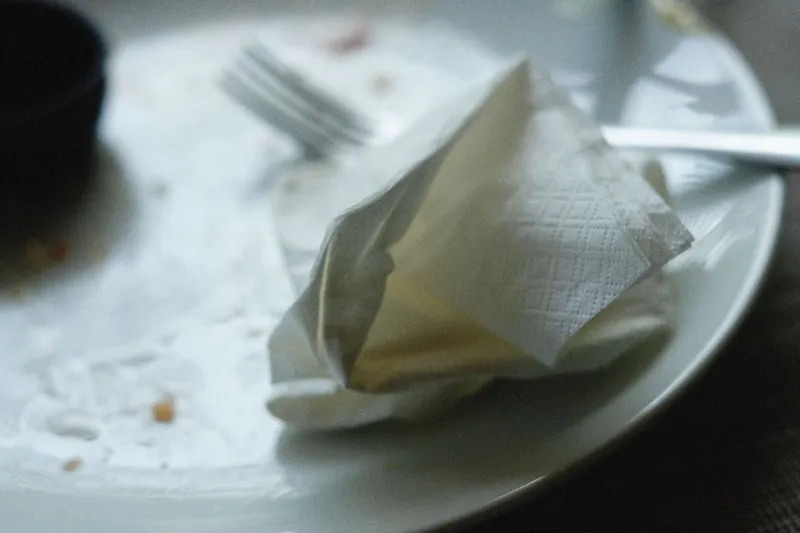
It happened again last Tuesday. I was mid-anecdote, fork resting against the rim of my plate in what I considered a universally understood "I am pausing, not finished" posture, when a hand materialized from my peripheral vision and swiped my lamb chop into oblivion. The lamb chop I had been thinking about since 11 a.m. The lamb chop I had budgeted for emotionally. Gone. Whisked away with the quiet efficiency of a CIA extraction, leaving behind only a faint smear of chimichurri and my own profound sense of loss.
This is not an isolated incident. This is America in 2025, where the gap between "fork rests" and "plate disappears" has shrunk to something measurable only by atomic clock.
A National Crisis Nobody Is Officially Calling a Crisis
Let's establish the scope of the problem. According to absolutely no formal study — because no academic institution has cared enough to fund this, which is its own indictment — diners across the United States report having plates cleared before they were finished eating at a rate that can only be described as "constantly" and "it's ruining my life."
We're not talking about the reasonable removal of a plate that's been sitting empty for twenty minutes while you nurse your second glass of Malbec. We're talking about the aggressive, preemptive strike that occurs the moment your utensil makes contact with the tablecloth. Busboys — and we say this with complicated affection — have developed a sixth sense for the exact millisecond your grip loosens, treating it as a starter pistol.
The phenomenon appears to be getting worse. Diners in New York City report an average plate survival window of roughly forty-five seconds after fork contact. In Los Angeles, where everything moves faster except traffic, the number reportedly drops to thirty. In the rural South, where hospitality is still treated as a moral obligation rather than a line item, your plate might actually survive long enough for you to finish a thought. Consider relocating.
The Restaurant's Side of the Story (They Have One)
In the interest of fairness — a quality Mr. Napkins extends grudgingly and only when legally advisable — we reached out to the restaurant industry for comment. The responses were illuminating, if not exactly exonerating.
"Table turns are everything," explained one restaurant manager in Chicago who agreed to speak on background because, and we quote, "my owner doesn't know I talk to food bloggers." "If we let every table sit for an extra fifteen minutes because someone wants to stare at their plate between bites, we lose a full seating on a Friday night. That's real money."
This is, admittedly, a coherent business argument. Restaurants operate on margins so thin they make paper look structural. A 200-seat dining room running two turns a night versus three is the difference between profit and a very expensive hobby. The economics are real.
But here's the thing: you, the diner, are also paying real money. In many cases, a lot of it. And there is something philosophically troubling about spending $38 on a plate of pasta only to have it treated like a NASCAR pit stop.
The Unwritten Signals and What They Actually Mean
Somewhere along the way, the restaurant industry developed a set of "clearing signals" — silverware positions supposedly indicating whether a diner is finished. The classic resting position (fork and knife angled across the plate at 4 o'clock, tines up) is supposed to mean "done." Parallel placement, tines down, means the same in more formal settings. Fork and knife crossed in an X means "I am still eating, please leave me alone."
The problem is that approximately 4% of American diners know this system exists. The other 96% are setting their silverware down wherever gravity and momentum take it, completely unaware they've just signed a legal document surrendering their entrée.
And even among those who know the signals, enforcement is wildly inconsistent. You can place your fork in the most emphatic "still eating" configuration known to culinary etiquette, and a sufficiently motivated busser will still read it as an invitation. The signals are a suggestion. The busser's instincts are a force of nature.
Regional Variations in Plate Aggression
Not all of America approaches this with equal urgency, and the regional differences are worth documenting for anyone planning to eat their feelings across multiple time zones.
New York: Plates are removed with the same energy that New Yorkers apply to everything — fast, efficient, slightly confrontational. If you make eye contact with the busser while still chewing, it will not slow them down. Nothing will slow them down.
The Midwest: A more measured approach, though this may simply be politeness masking the same impulse. Your plate will be cleared promptly, but the busser will apologize while doing it, which somehow makes it worse.
Texas: Table service in Texas operates on the assumption that you are a grown adult who will ask for what you need. Your plate will likely stay put, but so will your empty water glass, your used bread basket, and the centerpiece candle that went out forty minutes ago.
New Orleans: Nobody is clearing anything. Time moves differently here. Your plate, your dignity, and your sense of urgency are all safe. Order another Sazerac.
The Psychology of the Rush
Food psychologists — yes, this is a real specialty, and yes, they have opinions about your dinner — suggest that premature clearing creates a subtle but measurable anxiety in diners. When your plate disappears before you're done, your brain registers the meal as incomplete, which can paradoxically make you feel less satisfied even if you've consumed the same number of calories. You ate. But did you dine?
There's also the social dimension. Clearing one person's plate while others at the table are still eating creates a cascade of discomfort. The person whose plate remains starts eating faster. The person whose plate was taken feels obscurely guilty. The table's conversational rhythm collapses. Everyone orders dessert they don't want just to feel like the evening isn't over.
Restaurants, whether intentionally or not, have engineered a system that subtly pressures customers toward faster turnover while maintaining the aesthetic of hospitality. It is, if you squint at it from the right angle, a masterpiece of soft coercion.
A Modest Proposal
We're not here to destroy the restaurant industry. We love the restaurant industry. We have spent embarrassing portions of our income at the restaurant industry. But we'd like to suggest, gently and with great respect, that a plate still containing food is a plate that belongs to the person who ordered it.
Hold the table. Honor the fork. Let the risotto finish its story.
Because somewhere out there, a lamb chop is waiting to be eaten in peace. And it deserves better than this.