Bowl Movements: The Chaotic, Unregulated State of Soup Service in America
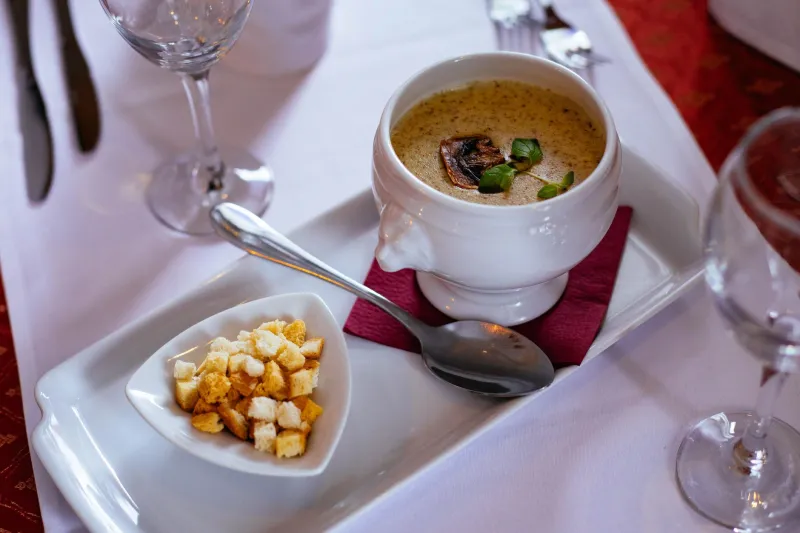
Somewhere between your first date and your last shred of dignity, you will be handed a soup spoon and left entirely alone to figure out what to do with it. Is it the right spoon? Is there a right spoon? Should you be tilting the bowl away from you like your grandmother insisted, or toward you like some kind of continental renegade? And why, at this particular restaurant, did they give you what appears to be a demitasse spoon for a bowl of clam chowder the size of a small satellite dish?
Welcome to the Great American Soup Situation — a culinary free-for-all that has somehow survived decades of food-media scrutiny, the rise of the Michelin Guide, and approximately forty seasons of Top Chef without anyone agreeing on a single standard.
The Spoon Problem (It's Worse Than You Think)
Let's start with the hardware, because this is where things go sideways immediately.
In theory, there are rules. A proper soup spoon — the round-bowled variety — exists specifically for the purpose of consuming soup. There is also the oval-bowled bouillon spoon, the long-handled iced tea spoon that has no business being near bisque, and the dessert spoon, which restaurants deploy when they've run out of every other option and simply hope you won't notice.
In practice? Restaurants use whatever's clean.
"We have three different spoon sizes in the back and honestly it depends on who's rolling silverware that night," admitted one server at a mid-range American chain in Columbus, Ohio, who asked not to be identified because, and we quote, "I don't want soup drama following me home."
This is not an isolated confession. Across the country, from Seattle's chowder houses to Miami's Cuban soup joints to the French-inspired establishments of New Orleans, the spoon situation is governed less by culinary tradition and more by the chaos theory of a Tuesday prep shift.
The Tipping Point: To Tilt or Not to Tilt
If the spoon debate is a simmering disagreement, the bowl-tipping question is a full rolling boil.
Classic Western etiquette, as handed down through generations of finishing schools and passive-aggressive family dinners, holds that you should tip the bowl away from you to capture those final precious spoonfuls. The reasoning is partly practical — it reduces drip risk — and partly rooted in the idea that leaning a bowl toward yourself looks like you're trying to drink it, which is considered gauche in polite company and absolutely acceptable everywhere else.
Marjorie Elliston, an etiquette consultant based in Charleston, South Carolina, has strong opinions on this. "The away-tip rule exists because it keeps the liquid moving away from your clothing," she explained. "But I've been to restaurants in twelve states this year, and I've watched people tilt bowls in every conceivable direction. At a certain point, you're just happy they're using the spoon at all."
Regional culture complicates things further. In certain Asian dining contexts — think miso at a Japanese restaurant or pho at a Vietnamese spot — lifting the bowl to your lips is not only acceptable but expected. The spoon, if present, handles solids. Your mouth handles the broth directly. It is efficient, it is honest, and it will make the person next to you at a mid-tier American fusion restaurant visibly uncomfortable.
Fine Dining's Soup Theater
If you want to see soup service at its most theatrical and most confusing, book a tasting menu at a white-tablecloth establishment and wait.
At this level, soup stops being soup and becomes "a warm preparation," "a consommé presentation," or — at one restaurant in Chicago that shall remain nameless — "a liquid meditation on celery root." It arrives in vessels that may or may not be bowls. Sometimes it's poured tableside from a small ceramic pitcher, which is elegant. Sometimes it's presented as a covered dome that the server lifts with a flourish to reveal broth beneath, which is theatrical. Occasionally it arrives inside something that used to be a vegetable, which raises questions nobody asked.
The spoon, if it appears at all, is typically the size of a guitar pick and made from something artisanal. You will use it four times and feel vaguely cheated.
"We spent three weeks sourcing the right spoon for our mushroom broth course," a chef at an upscale New York tasting menu restaurant told us. "It needed to feel intentional." We did not ask what happened to the broth itself. We assume it was also intentional.
The Diner Exception (God Bless It)
And then there is the American diner, which operates in blissful defiance of every convention listed above.
At a diner, soup comes in a bowl that could double as a serving dish. The spoon is large, slightly bent from years of service, and absolutely correct for the job. Nobody is tilting anything. Nobody is meditating on celery root. You are eating vegetable beef soup at 11 a.m. on a Wednesday and the only judgment happening is from the guy two stools down who ordered pie for breakfast, and even he's minding his business.
This, argues food writer and longtime diner enthusiast Carla Briggs of Austin, Texas, is the soup experience we should be protecting. "Diners figured it out decades ago. Big bowl, big spoon, no drama. The fine dining world has been overcomplicating soup ever since someone decided a wide rim was sophisticated."
She is not wrong. The wide rim, incidentally, is another point of contention — wide-rimmed bowls are harder to tilt, harder to drink from, and primarily exist to give the kitchen more canvas for decorative drizzle, which is its own article entirely.
What You Should Actually Do
Here is the honest answer, delivered without the pretense of a definitive ruling: there is no universal correct way to eat soup in America because America has never agreed on anything soup-related, and it is not starting now.
Tip your bowl away from you if you're somewhere with cloth napkins and someone else's money paying the bill. Lift the bowl to your lips if the cuisine calls for it and you're confident in your surroundings. Use whatever spoon arrives and do not ask questions. And if the establishment hands you something the size of a cocktail stirrer for a sixteen-ounce bowl of French onion, you have every right to raise an eyebrow, flag down your server, and request something more structurally appropriate.
You may not get it. But the ask is legitimate.
Mr. Napkins recommends keeping a backup spoon in your coat pocket. We're not joking. We're barely joking.