Fire on the Table: A Survivor's Guide to Restaurant Theatrics That Have Gotten Completely Out of Hand
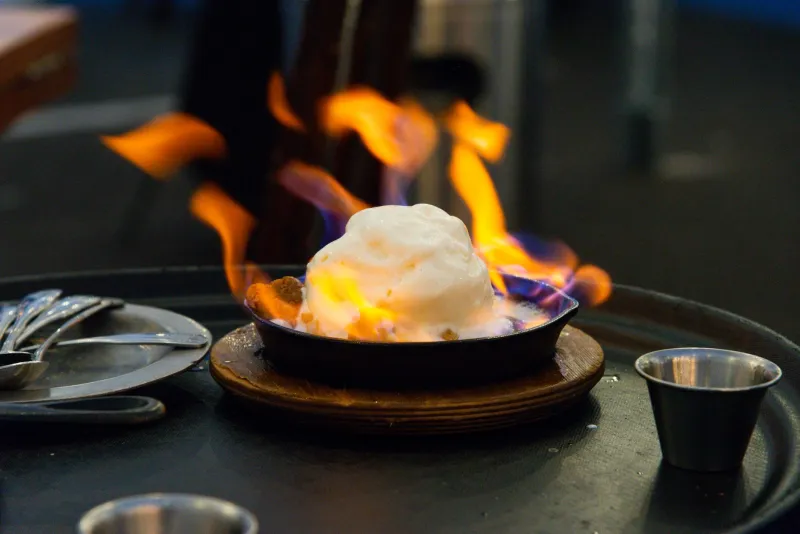
I want to be very clear about something before we begin: I have nothing against drama. I enjoy a good entrance. I appreciate effort and presentation and the theatrical impulse that makes humans want to make things more interesting than they strictly need to be. I get it.
What I cannot support, what I will not support, is a situation in which I am trying to have a quiet dinner on a Tuesday and a server arrives at my table carrying what appears to be a small flaming cauldron and the energy of someone who just completed a week of intensive performance training.
American dining has a theatrics problem. It started innocently enough — a little tableside guacamole here, a Caesar salad assembled with ceremony there — and it has evolved into a full-blown production industry in which the meal is almost secondary to the experience of watching it be prepared, ignited, smoked, or dramatically revealed. The food, in many cases, has become a prop.
The Origin Story Nobody Asked For
Tableside service has actual historical legitimacy. Dishes like Bananas Foster, invented at Brennan's in New Orleans in 1951, were cooked tableside out of necessity and showmanship in equal measure. The flambé was a genuine technique, not a gimmick. The Caesar salad, famously assembled tableside at Caesar's in Tijuana, was theater that also happened to be delicious. These were the founding documents of a reasonable tradition.
Then someone put a smoke dome over a cocktail and everything went sideways.
The modern tableside experience is less about technique and more about content. Restaurants have discovered, somewhat correctly, that people photograph things that are dramatic, and photographs on social media are essentially free advertising. The smoked old fashioned under a glass cloche. The liquid nitrogen dessert that arrives like a special effect from a 1980s music video. The cheese wheel pasta that gets made directly on your table, usually by someone who seems slightly nervous about the whole arrangement. These are not cooking techniques. They are marketing strategies wearing chef's whites.
A Risk Assessment of Common Table-Side Stunts
In the spirit of genuine public service, here is an honest evaluation of the theatrical flourishes currently circulating through American restaurants, ranked from "actually fine" to "I have concerns about this situation."
Tableside Guacamole — Low Risk, High Reward This is the gold standard of acceptable tableside theater. You watch someone mash avocado. You provide input on the lime-to-cilantro ratio. You feel involved. The guacamole arrives at the correct temperature because it was just made in front of you. Nobody is in danger. This is the one. This is the template. Everything else should aspire to this level of benign interactivity.
Caesar Salad, Assembled Tableside — Acceptable with Caveats Respectable tradition. The risk is mostly to the server, who is working a wooden bowl and raw egg situation within three feet of your white shirt. Proceed with cautious optimism.
Cheese Wheel Pasta — Moderate Risk, Spectacular Mess Potential The concept is genuinely clever: hot pasta tossed directly in a hollowed wheel of Parmigiano-Reggiano, the heat melting the cheese into the sauce. The execution depends entirely on how confident your server is. A nervous cheese wheel situation is a slow-motion catastrophe. Pasta goes everywhere. The wheel is not stable. Someone always gets hit with a noodle. Worth it when it works. Deeply chaotic when it doesn't.
Flambéed Desserts — High Drama, Variable Outcome The bananas Foster is fine. The cherries jubilee is fine. The problem is that every mid-tier steakhouse in America has decided to offer a tableside flambé experience performed by staff who received approximately twenty minutes of training on the subject. The result is a fire that is either underwhelming (a brief blue flicker that disappoints everyone) or genuinely alarming (a sustained flame that causes neighboring tables to look over with concern). There is rarely a middle ground.
Smoke Domes and Fog Machines — Proceed with Skepticism A smoked cocktail under a glass dome is a reasonable novelty exactly once. After that, you are paying for a theatrical effect that contributes nothing to the flavor of your drink and primarily serves to make the table smell like a campfire for the next forty minutes. The smoke dissipates. What remains is a regular cocktail and a faint sense of having been gently deceived.
Blowtorches Applied to Food at Your Table — Do Not Make Eye Contact I have watched servers torch the sugar on a crème brûlée approximately six inches from my face. I have seen tableside s'mores kits that involve an open flame, a stick, and an atmosphere of barely controlled uncertainty. I once witnessed a tableside beef tartare situation in which a small torch was used to sear the edges of something that is, by definition, supposed to be raw. Nobody involved seemed fully comfortable. This category of theater should require a waiver.
The Temperature Problem
Here is what nobody in the theatrical dining industrial complex wants to acknowledge: all of this takes time, and food has opinions about time. Hot food cools. Cold food warms. The window between "correct temperature" and "disappointment" is narrower than most tableside presentations allow for.
While the server is assembling your Caesar salad with the careful attention of someone defusing a small bomb, the croutons are getting soggy. While the cheese wheel pasta is being tossed with theatrical confidence, the pasta is losing heat at a rate that physics finds completely non-negotiable. While the flambé is doing its thing, the ice cream underneath it — if there is ice cream, and there often is — is melting into a warm puddle that will be lukewarm by the time the fire goes out and the plate reaches you.
The theater and the food are in direct competition with each other, and the food usually loses.
What We Actually Want
Here is a radical proposal: cook the food in the kitchen, where the equipment is designed for cooking food, and bring it to the table hot, at the correct temperature, in a state that reflects the chef's actual intentions for it. That's the show. That's always been the show.
The best meal I've had in the last year was a bowl of pasta at a place in Chicago where the server did nothing except set the bowl in front of me and say "careful, it's hot." It was hot. It was perfect. I did not photograph it. I ate it immediately.
Nobody's eyebrows were harmed in the making of that dinner.